Showing posts with label Japan. Show all posts

Wednesday, December 21, 2011

Sodegaura Raceway : Video Drive of the 2013 Scion FR-S


Among all new car presentations made in 2011, the models that received the most attention from auto enthusiasts all over the world this year were arguably the sports coupe triplets born from the partnership between Toyota and Subaru.

But that was to be expected as affordable and focused rear-wheel drive sports coupes have become an increasingly rare sight in our days.

At least in the U.S., we'll have wait until next spring to see how affordable the Subaru BRZ and its Scion FR-S twin will be, but in the meantime, both Japanese carmakers are giving the press some time behind the wheel to evaluate their creations.

In this latest video, we see Michael Ferrara from DSPORT magazine trying out the Scion variant, both with manual and automatic transmissions at the Sodegaura Raceway in Japan, while wWe also get a few quotes from the car's Chief Engineer, Tetsuya Tada.

You can check out the video after the break.

Hat tip to Frisco for the video find!


Sunday, September 25, 2011

Threat Or Request : Suzuki Tells Volkswagen to Take Back Statements on Breached Contract or Else…

Hell hath no fury like a woman Suzuki scorned. On Thursday, the Japanese carmaker's CEO, Osamu Suzuki, sent a letter to his counterpart at VW demanding that the German group retracts its statement about Suzuki breaching their 2009 contract.

The spark that ignited this heated war of words between the two partners was Suzuki’s decision to choose Fiat as a supplier of diesel engines instead of VW. The German group said on September 11 that Suzuki had breached their contract with this decision, while Suzuki vehemently denies it violated the terms of their agreement.

A furious Osamu Suzuki said that he wanted to get rid of the VW “ball and chain”, demanding that VW returns its 19.9 stake in Suzuki, which will in turn hand over its 1.9% stake in VW.

Suzuki’s CEO claims that after VW’s diesel engines failed to meet the Japanese carmaker’s criteria, the German group was consulted about negotiating with Fiat thus its allegations of being unaware are false.

In addition, Suzuki also said that his company was denied access to much of VW’s technology despite promises to the contrary when the original deal was sealed.

Though the Germans don't want a divorce, the Japanese are ready to fight for it. We suspect the “War of the Roses” has just begun.

Story source: Automotive News [Sub.req.]


Mitsubishi to Sell Rebadged Infiniti M as its New Flagship Sedan in Japan

Mitsubishi may have a wide range of vehicles, but it lacks a flagship model since it stopped production of the Diamante back in 2005. However, that will change soon.

Today, the troubled automaker announced that, as a part of cooperation agreement signed with the Nissan Group in December 2010, it begin selling a rebadged Fuga, which in the rest of the world is known as the Infiniti M, from next summer.

Even though Mitsubishi had already begun development of a successor to the Diamante, the model’s low sales, which dipped below 10,000 units in its last year of production, along with the company’s economic problems, killed off the project.

According to Mitsubishi, the rebadged luxury sedan will be sold only in Japan and there are no plans to export the car in overseas markets. The Japanese automaker has yet to reveal the flagship sedan's name.

The cooperation between the two companies extends beyond the M sedan, as Mitsubishi has already agreed to sell Nissan’s NV200 van while providing Nissan with the electric Minicab i-MiEV commercial van.

The two Japanese makers have also formed a joint venture for the common development of mini cars for their home market.

Story source: Autonews


PHOTO GALLERY

Tuesday, September 20, 2011

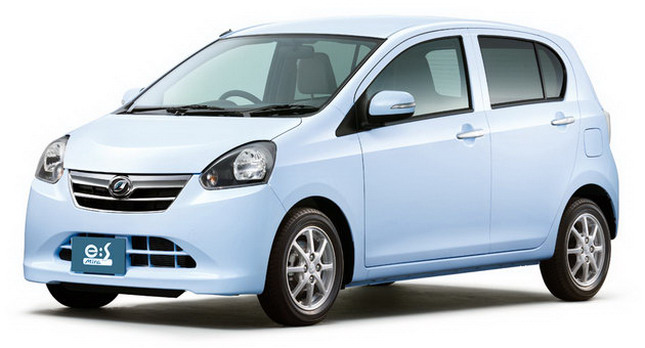
Daihatsu Presents New Fuel-Efficient Mira e:S in Japan


Toyota's daughter brand of small vehicles, Daihatsu, has launched a new version of its Mira kei car called e:S incorporating a raft of new or revised technologies, all of which aim to improve fuel efficiency.

Daihatsu says that it has overhauled all existing aspects of the engine, the transmission, and the body structure, to make the most of energy efficiency and as a result, says that the Mira e:S is almost 40 percent more fuel efficient that current mini cars with engine displacements of up to 660 cc [0.6-liter].

The Mira e:S is powered by a three-cylinder 650cc gasoline engine that produces an output of 52PS (51HP) at 6,800rpm and 60Nm of peak torque at 5,200rpm.

According to the Japanese firm, the Mira e:S delivers a fuel economy of 30.0km/L (about 70.5mpg US) on Japan's JC08 Mode test cycle, and 32km/L (approximately 75.2mpg US) on Japan's 10-15 Mode test cycle.

Pricing of the Mira e:S in Japans starts just under 800,000 Yen (equal to US$10,450 or €6,651).

Hat tip to Leopaul for the heads up!


PHOTO GALLERY

Monday, September 19, 2011

Rumors: New Lexus LFA Special coming to Tokyo Show while Toyota is Working on a Supra Successor


After losing ground globally to its main competitors, Toyota is on the offensive again. Not only are its plants starting to operate near their maximum capacity, it has also formulated a new strategy to recover as quickly as possible.

However, bread-and-butter models are not the only vehicles the Japanese automaker has in store for us. According to CAR Magazine, Lexus will launch a Tokyo Motor Show Edition of its LFA supercar at its home motor show in autumn.

This edition of the LFA, the second after the Nürburgring special, will sport an unpainted carbon roof and rear spoiler and will cost around €40,000 (US$54,500) more than the “normal” production model.

Meanwhile, the proposed open-top version of the Lexus LFA will not make it past the drawing board due to the current global economic climate.

Coming a little down to earth, Toyota is readying a successor to the Supra coupe of the ‘90s. Although the company has officially denied such a project even exists, the same sources insist that an unsanctioned RWD sports car is currently under development.

Toyota, which has abandoned the sports car segment for quite some time to focus on hybrids, is also said to be working on a front-wheel drive performance car that is expected to be a GTI-rivaling version of the CT200h hatchback.

Perhaps the biggest news, however, is that Japan’s number one car maker is contemplating moving away from naturally-aspirated, high-revving engines and follow the downsizing trend, adopting turbocharged units for its sports models.


PHOTO GALLERY

Sunday, September 18, 2011

Toyota Will Build Hybrid Drivetrains in Four Years Out Of Japan


Toyota Prius Family

Toyota has chosen to focus most of its resources on its hybrid models, and more specifically on the Prius “family” and Lexus lineup, in order to recover from this year’s earthquake and the subsequent, and quite substantial, decrease in global sales due to parts shortages.

Until now, Toyota manufactured all components of hybrid drivetrains, such as battery packs, electric motors and inverters only at its Japanese plants. The recent disaster has shown the vulnerability of the decision to put all of your eggs in one basket.

Therefore, the company has decided to change its policy and manufacture them not only in Japan but also in overseas factories.

“Right now, hybrid component production is too biased toward Japan”, Toyota’s executive vice president in charge of global purchasing, Shinichi Sasaki, told Automotive News. “We have to devise a tactic roughly within a year –that means this may be implemented in three or four years’ time.”

According to Mr. Sasaki, Toyota’s revised plan calls for the production of Toyota and Lexus hybrid components at global production centers that will then ship the parts to assembly plants worldwide. He added that the most likely choices would be Toyota’s North American, Southeast Asia and China plants.


PHOTO GALLERY

Friday, September 16, 2011

Japanese Tuner Sheds Some…LEDs on the Lamborghini Diablo [Video]


If you found the LED adorned Ferrari 458 Italia to be an overkill, wait until you check out this gem created from a Japanese audio and light systems specialist called Diecock – no seriously, that is the company's name.

Make the jump below and see what you should never do to a Lamborghini Diablo.

Hat tip to Alex!

Video:


Tuesday, September 13, 2011

Toyota Focuses Recovery Efforts on Prius Hybrid Family

The March 11 earthquake that shook Japan to its core had many collateral damages, one of which was vehicle manufacturing. For example, more than 650 of Toyota’s suppliers suffered great damages and halted production, forcing the Japanese automaker to reconsider its strategy. Two weeks later, its management had reached the conclusion that it should focus its worldwide resources mainly on one model line. “We were rapidly burning through cash, so in order to survive this we prioritized the cars our customers wanted most” explained head of production Atsushi Niimi.

So which vehicles were the chosen ones? Could it be the cars that helped it the most to become the world’s number one car manufacturer since 2008? Nope: Corolla and Camry would have to take a back seat to hybrids, and especially the Prius. Therefore, Toyota started off by ensuring that it could find parts for the Prius and the Lexus hybrids.

“The last several years have been a triple shock for Toyota” said Masatoshi Nishimoto of Tokyo-based consulting company HIS Inc. “It’s now at a major turning point.”

The first came in 1990. Up until that point, six of the world’s 10 biggest companies were Japanese, with Toyota in ninth place. When the real estate bubble burst, things changed dramatically: Toyota is the sole Japanese company in BusinessWeek’s top 50 ranking, down to 35th place.

Then there was the 2009-2010 floor-mat and sticky pedal recall saga. The way it was handled resulted in a $16.4 million dollar fine by the NHTSA and millions of recalls – which meant more millions lost, and perhaps more importantly, the loss of Toyota’s reputation as the manufacturer of the world’s most reliable cars.

This year’s earthquake, along with the strengthening of the yen against the US dollar, made things even more difficult as of all Japanese car manufacturers, Toyota is the one that builds the most cars domestically.

Toyota will certainly lose the number one spot on world sales to General Motors this year and Lexus, after a decade, falls behind rivals BMW and Mercedes-Benz. Now, Akio Toyoda is betting his company’s future on hybrid technology and especially the Prius. The three new models of the world’s best-selling hybrid take center spot have to succeed if the company is to make a quick recovery.

Story source: Bloomberg

Photo Gallery:


Friday, September 9, 2011

American Idol: U.S. Market Toyota Camry to be Built Exclusively in the Land of the Free


Toyota Camry

The Toyota Camry has been the best-selling car in the US for nine straight years. Yet, in its home market, it is virtually non-existent: even though it sold 82,000 cars in 1990, last year Toyota couldn’t shift more than 1,100 units! That’s because Japanese buyers prefer either the more sporty Mark X or the more luxurious Crown.

Therefore, for its seventh generation, which was only recently unveiled, Toyota decided to phase out imported Camrys from Japan and instead manufacture all cars earmarked for the North American market at its own plant in Georgetown and Subaru’s factory in Indiana.

“North America will be self-sufficient. The current US production capacity is sufficient to produce the vehicles we plan to sell” says Yukihiro Okane, chief engineer for the new Camry which goes on sale later this month.

This doesn’t mean that the mid-sized sedan won’t be manufactured in Japan anymore. It will still be produced at the Tsutsumi plant in Toyota City, albeit at a much reduced rate. Toyota aims to manufacture and sell 360,000 units annually in the US, while in Japan it will build 30,000 units, only 6,000 of which are destined for the local market.

Okane explains one of the reasons: “This Camry was developed in Japan, which means that production and design engineering originated here. So, at the moment, it’s most effective to manufacture it in Japan and, starting with Tsutsumi, deploy manufacturing globally.”

The second reason is the Camry’s hybrid version. Toyota aims to sell 50,000 hybrid Camry sedans per year in the US. They may be locally built, but all the hybrid components including batteries and electric motors, are manufactured in Japan. So it makes perfect sense, and is much more cost effective, to keep the domestic production line open.

Story source: Automotive News [sub. req.]


PHOTO GALLERY

General Motors Takes Over Japan's Import Operations


CADILLAC CTS

General Motors has announced that it is consolidating imports to Japan, terminating the cooperation with its local partner, Mitsui Bussan. The move, which will go into effect on November 1, is intended to improve GM's image and, more importantly, streamline the sales process.

Since 1992, Mitsui Bussan has imported a total of 12,000 GM models that were mostly sold through its own dealer network, although some were distributed by GM official dealers. Its sales have been falling since 1995.

So far, GM’s penetration in the Japanese market is small, but the American company wants to change that by improving both its Chevrolet and Cadillac brands position.

This will be achieved not only by improving its network but also with the introduction of new models like the Camaro, the Captiva crossover and, later this year, the Sonic sub-compact.

Story source: Autonews [Sub. req.]


PHOTO GALLERY

Linkwithin

Related Posts Plugin for WordPress, Blogger...